02-August-2026
Steps: 39,769
Miles: 15.4
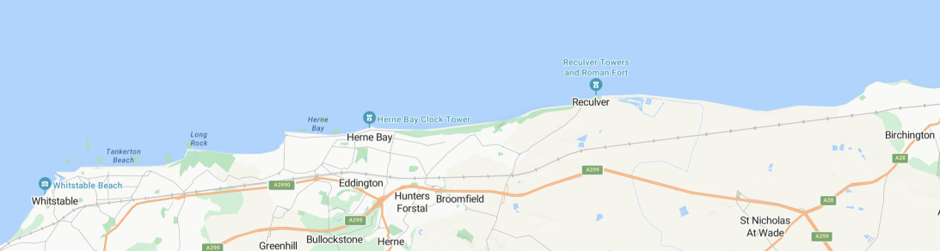
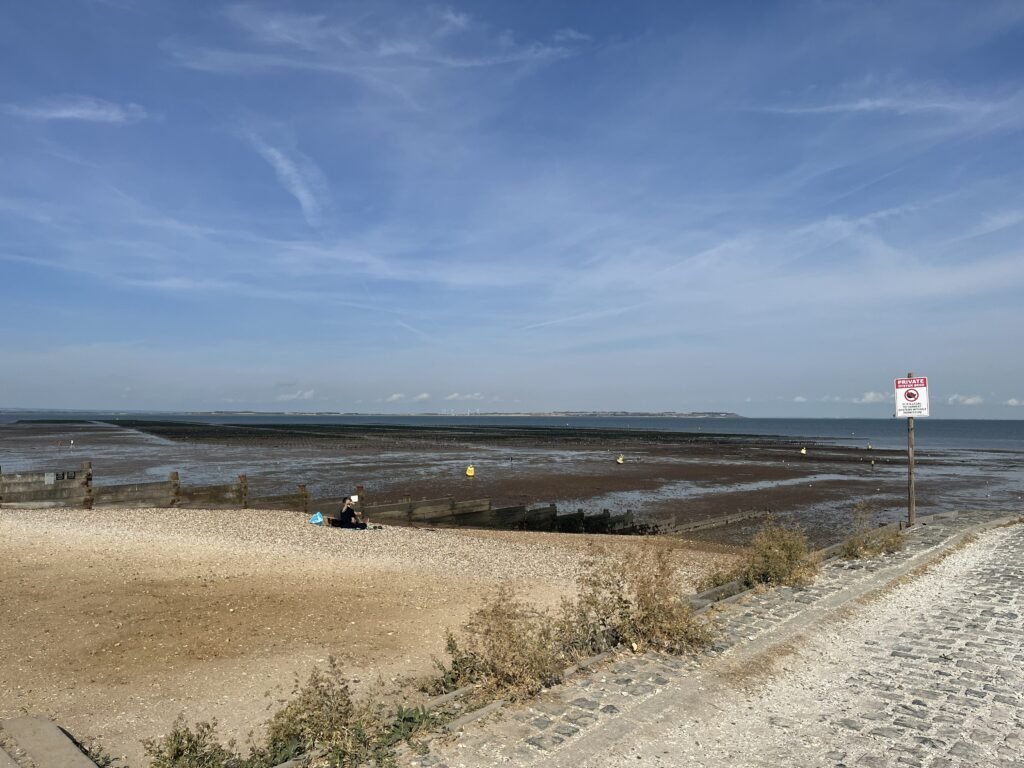
Every walk has to start somewhere, we are starting from Whitstable, as it was easy to organise, close to home and has a natural barrier of the Thames. So our first steps were from outside the Whitstable Oyster Company’s seafood restaurant overlooking the oyster beds that were in full view as low tide. The night before was the carnival with takeout beers being mandatory and the party in full flow. This morning felt altogether calmer and Whitstable was a quaint fishing village with queues for coffee and sourdough being all the rage.
Looking out to sea you are struck by the oyster beds, a coast line that idealistically was France but in actuality was Essex, wind farms, some strange looking War of the Worlds-like monsters and a solitary large skiff-like boat, slowly moving on a single triangular sail. From the information boards in the harbour this could well be the last active boat still in service that played its part in the Dunkirk saga.
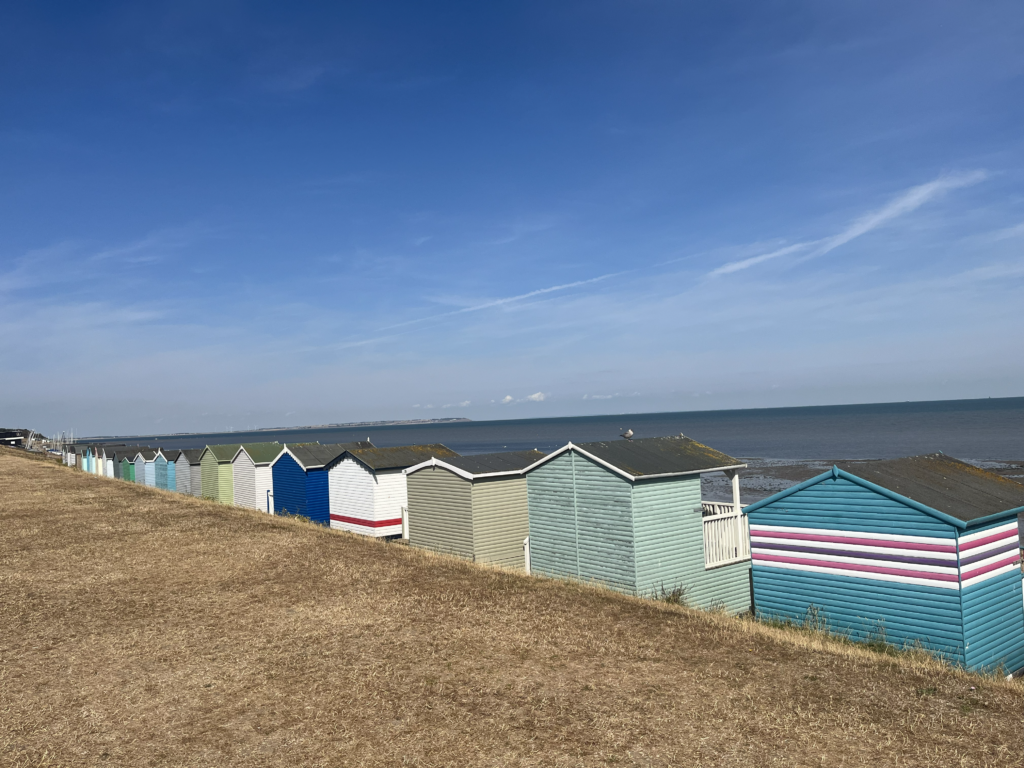
Leaving Whitstable, we arrived quickly at Tankerton Sands, with is long rows of beach huts and wide, largely empty beach with the huts massively outnumbering people. Peeping inside there is a standard design, a cloth curtain covering shelving with a gas kettle on top and a range of cups to suit all drinks. Unfortunately, my suspicion is that the beach huts are going along the same wave of decline that has struck so many of the mainstays harking back to when a British coastal holiday was the de facto family affair.
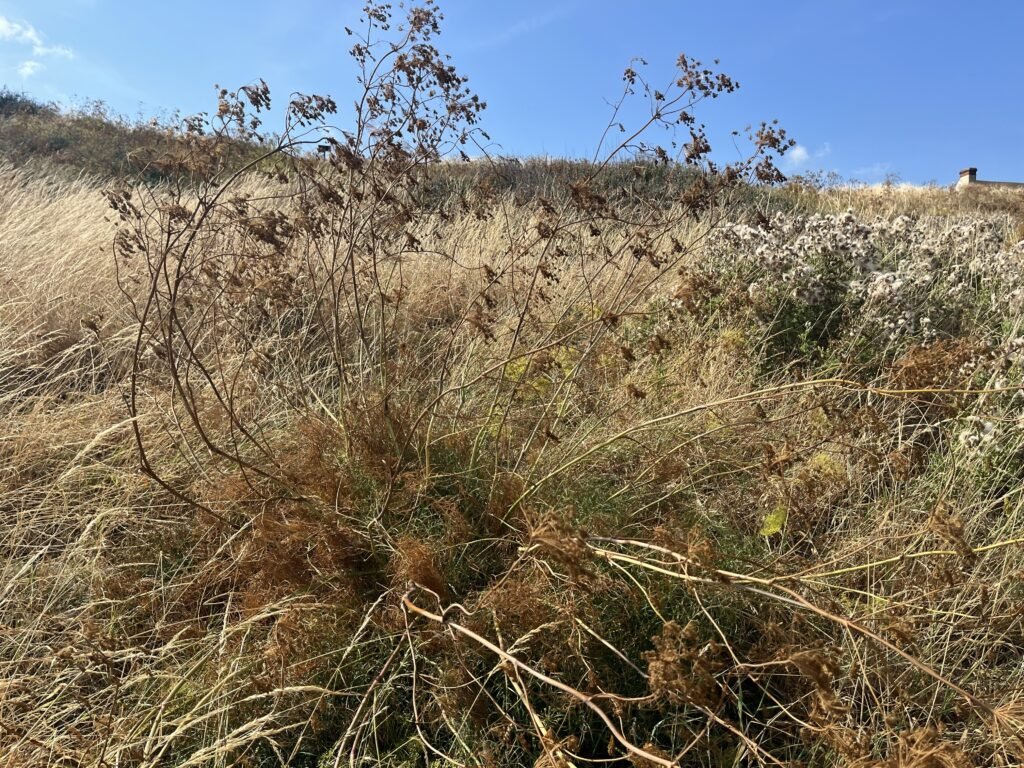
The notice boards along this stretch were excellent, one of the first drew attention to Hogs fennel, Peucudanum offinale, a plant that is very similar to cow parsley with yellow umbrella flowers that is only found along this stretch of coast and on the Essex shoreline. Even stranger is that Hogs fennel supports 2 species of moths who are completely dependent upon it as their caterpillars feed exclusively on its leaves and stems. They are the Fishers estuarine moth and Agonopterix putridella. Ultimately all three species are hanging on in there, the plants are abundant in the area but no moth sightings to report probably as they are a very dull brown, blending in with the parched landscape.
On from Tankerton Sands was a small nature reserve on Long Rock. It is so dry at the moment that there were few signs of waders and the birds were largely restricted to large quarrels or hosts of sparrows. Quarrel of sparrows strikes me as apt as they are noisy neighbours. The signs highlight an abundance of potential sightings but most of migratory coming here for the winter, hopefully when the lakes and gullies have more water than now.
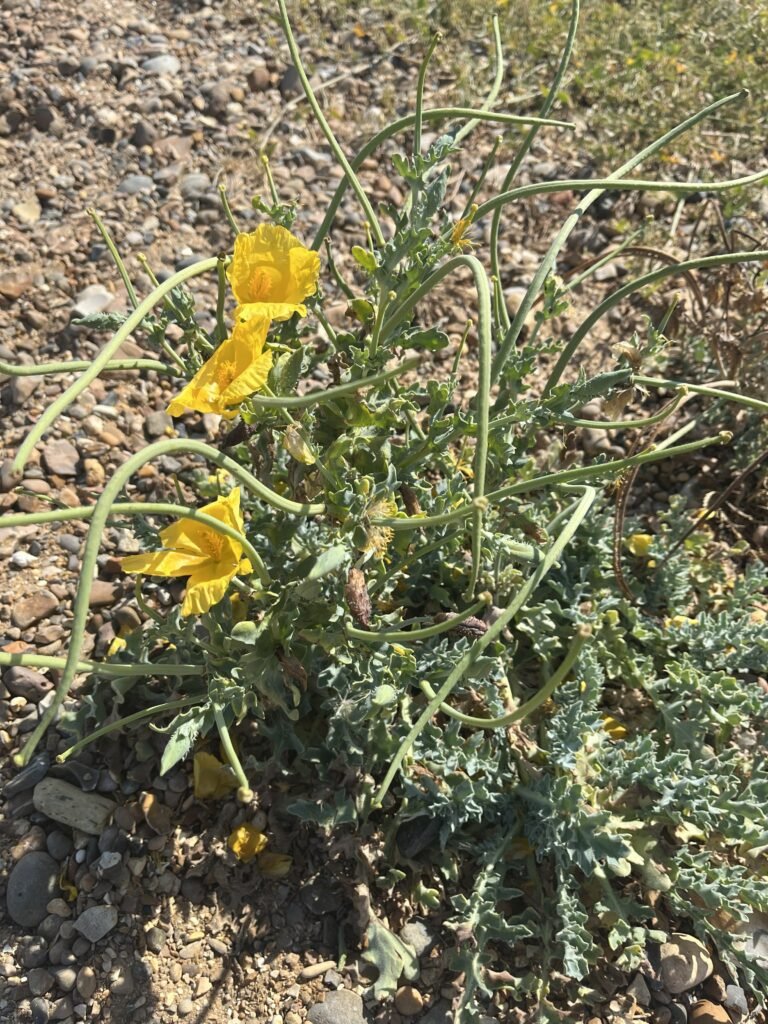
On to Swalecliffe Beach, another pebbled affair with the prerequisite groynes to prevent erosion. Where there is stability in the pebbles, colonising plants are having a go, with the most beautiful being the Yellow Horned-poppy. It looks extremely tough with fleshy silvery leaves to retain water, spectacular seed heads and to give itself a chance the whole plant is toxic.
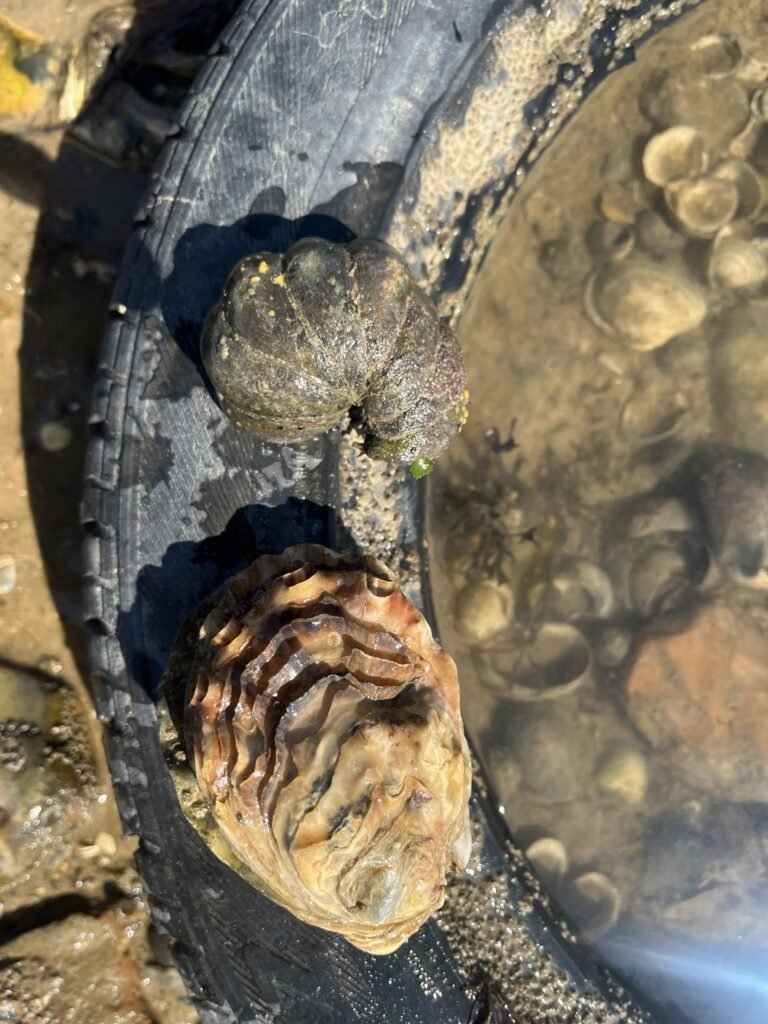
Swalecliffe Beach presented the first major caravan park on it, apart from a few small games of family cricket and a coned off area where 4 dogs were undertaking behavioural training, there was a complete absence of people. We dropped down onto the beach here scavenging for pebbles and anything of interest. The highlight was that discarded tyres were making isolated rock pools where no others existed that contained life that could be examined using my binoculars. Present were small fish and shrimps but most interesting was what looked like a lobster tail but was in fact a series of conjoined slipper limpets (Crepidula fornicate) which was a first sighting from me. These are an invasive creature from North America that were introduced in oyster cargo from the Americas. There are now troublesome on oyster and mussel beds and increasingly common throughout the British coastline. Oyster shells were also everywhere though so not too much sign of damage.
After 2 hours of walking we arrived in Herne Bay ready for breakfast and loosening off our boots. The Bay on the promenade protected us from the breeze and served a lovely breakfast of avocado on sourdough with poachies. My first ever poached eggs at the age of 54 and embarrassingly I loved them.
The Bay Steak & Seafood | Discover Fresh Seafood & Steaks – Book Now
Herne Bay was excellent, rich with historical artefacts. The end of a pier standing proudly isolated a mile out to sea as an island. It once took passengers from London and the continent and even had a sail powered means of shipping luggage to shore. It is also the site where Amy Johnson, the world renowned aviator crashed at see whilst moving planes during the 2nd World War, it is ironic that she flew with no navigation to Australia, South Africa and America but finally came down so close to home.
After Herne Bay, you are on the long approach to Reculver, that sits prominent on the cliff tops in the distance. The tide was coming in so we had to move onto the cliff tops which were wonderful. Where the drought had seen off so many flowers here they were abundant, and with them came insects and butterflies and sand martins taking them dynamically on the wing. Where there were Cornflowers as we approached them scores of butterflies would flutter up into the air.
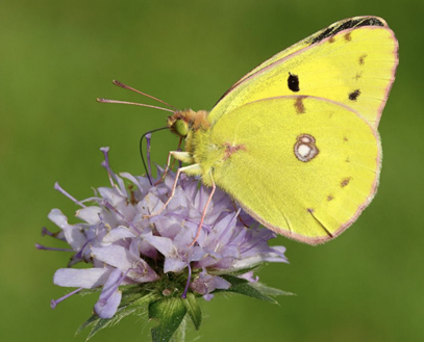
There were 2 butterflies that caught my attention more as they were yellow, and identified them as Clouded Yellow and Berger’s Clouded Yellow.
Now home, perhaps they were all Clouded Yellow? But whatever they were lovely to see amongst the Common Blues and other butterflies.
Clouded yellow | The Wildlife Trusts
Earlier in the day, I cannot recollect why but I asked Kim ”who were the Saxons?” and we were indeterminate. Who would of known the answer lay in wait for us at Reculver?
History of Reculver Towers and Roman Fort | English Heritage
Approaching the building was almost restricted to 2 high towers that were adjoined acting as an ancient watch tower over the land and sea positioned on the highest point in the area. Its strategic position makes it history fascinating; originally it was the Roman fort of Regulbium that was a walled station for army units, sailors and trade from 200AD and in the 4th century AD they were patrolling the seas to protect from Saxon and Frankish raiders. Eventually the Romans left, the fort neglected until AD 669 when Bassa, a priest from Canterbury built a monastic church within the walls which is thought to of been abandoned again due to Viking invasions around 8-900 AD. The Normans used as a church again until 1805 when they moved the church inland and blew up the church leaving just the towers.
After an iced coffee and ice cream we headed on, down to the coast again. I always knew people referred to the Isle of Thanet but did not realise that it originally was. We were now walking on the sea wall of reclaimed land, which was very low, flat and mainly agricultural. Reculver originally sat at the northern end of the Wantsum Channel that separated the Isle of Thanet from the mainland until the middle ages when it silted up. There were salt marshes on this stretch but still largely bird free over and above starlings, terns, gulls and oyster catchers but we did see both the Greater and Less Egret, the Greater Egrets sunning themselves at the top of a tree and a solitary Lesser Egret looking chilly with coat fluffed up by a salt marsh.
The sea wall we walked along was long and straight as a die, neither good or bad, just straight. Towards the end whilst in bird watching mode, a group of swimmers caught our eye as they were very distinctive, like birds, very black and white with adornments; hats, and tassels of hair and shirts. It was a group of male orthodox Jews swimming and resting. A little further on, before reaching mass civilisation there where more family groups of Jews, with the groups children, mainly the girls in matching coloured outfits, pale pinks, blues k and greens like Robin Hood. There were so many children and more groups coming in in big vans and people carriers but strangely on the fringes of society.
As we got towards the town, the Jews stopped and traditional holiday makers came to the fore. One family in a inflatable dinghy could easily been our first illegal immigrant boat spotted, call Rupert Lowe and the coastguard. Finally the beach ended, the sea walls became more prominent, and some high quality chalk graffiti appeared which will have its own section.
Up onto the greens of Birchingham on Sea and off to the station to take the 15 min train back to Whitstable but it was pleasing to see some of the sights going back and realising how far we had gone.