17-August-2026
Steps: 34,669
Miles: 13.8
We made sure we had food today to ensure no repeats; egg sandwiches, chocolate wafer biscuits and salted almonds and cashews.
We also enjoyed coffee on the end of the pier which was lovely. There was nothing else really on the pier apart from a German mother trying to keep her boys occupied catching crabs as was running out of options for things to do and people fishing off the end. There were 3 generations of London boys out for the day, stripped down to shorts and bucket hats who were super friendly.
After Whitstable’s Wetherspoons being named after Peter Cushing, was Deal an upgrade, theirs was the Sir Norman Wisdom who was brought up in Deal. One of the Blue Plaques though we saw was for Charles Hawtrey, who was one of the Carry On regulars but maybe not for Wetherspoons.
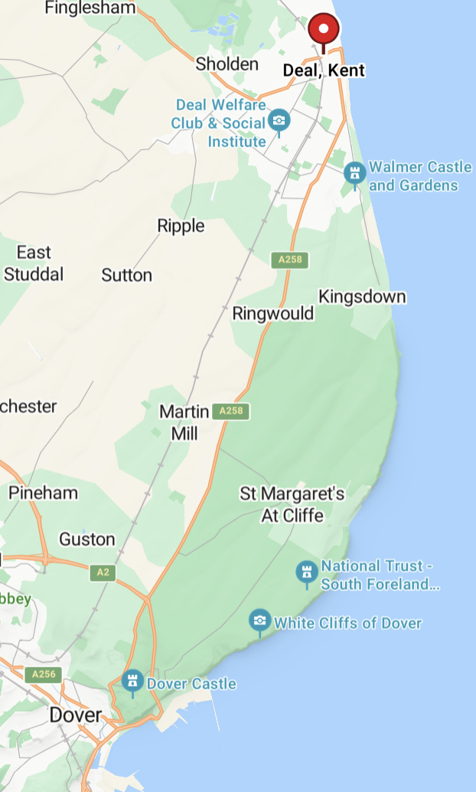
The outskirts of Deal had the customary band stands and a fantastic free lido for small children. As we were planning to walk a little less distance we wanted to also take in the attractions, the first of which was Walmer Castle. This was a wonderful treat. We were welcomed by the gardens which had a magnificent Dahlia bed, then roses, asters and it went on and on. There were veg gardens, a Queen mother gardens as she was a former Lord Warden and tropical gardens filling the sheltered moat.
Again, like Deal Castle, this was built in 1539. All 3 castles were built in 18 months by a huge workforce. In Deal we could see the French mainland for the first time. Walmer was much bigger though than Deal Castle with further refinements added using the stone from the first castle for materials.
Inside the Castle we could see the Lord Warden’s living quarters, which allowed us into the Queen Mother’s bedroom. The Lord Warden of the Cinque Ports is an ancient position dating back to the 12th Century, to protect the south coast on England. The Cinque Ports were; Sandwich, Dover, Hythe, Romney and Hastings. Famous Lord Wardens include; Duke of Wellington, Churchill, Pitt and the Queen Mum who all apart from Churchill stayed there once per year at least.
Again the volunteer guides were amazing. In one room though we got cornered by a young historian from Broadstairs who was quizzing us on a picture of Wellington’s banquet asking us if we knew who person A was, anyway he was the spit of Mike Brearley and David Gower also appeared to be present but when mentioned Kim rapidly shut me down as it was deemed to be an act of bullying unlike being trapped by the zealous guide.
A little further along the beach, the signage highlighted we were where Caesar landed on the 26th August 55 BC. Apparently Dover was well protected so he landed on the shingle beach here. He only stayed a few weeks as he was unable to secure resupplies. He returned a year later landing in Pegwell Bay again marching in land but ultimately leaving for Gaul again within a couple of months.
The beaches were colonised as well by very prostrate Holm Oaks providing deep cover and apart from their stunted height, flouringly. Not wanting to make a fateful error we also stopped at the last pub in Walmer, the Zetland Arms for the most perfect pint of Spitfire (and the food looked amazing).
Then we were off, after Kingsdown we were up on the cliff tops for the day (another good choice as the tide was in and the beach impassible). The weather, views, butterflies and birds made this lovely. We dropped down what felt like too many steps into St Margaret’s At Cliffe to be welcomed by ice cream vans where a Franco’s Lemonade ice lolly hit the spot. Then we had to climb up again out of the village.
We then reached South Foreland lighthouse which is managed by the National Trust. I would never of guessed how interesting a tour of a lighthouse could be. Simon took us around and it was amazing, a few of the facts that stuck with me were:
- Lighthouses were managed by Trinity House and the lighthouse keeper would record every passing ship to charge them a fee for passing their lights when they eventually docked.
- The lighthouse’s lens and lights rotated due to weights descending down the tower that the keeper would have to raise every 2 hours.
- The lamps weighed 3.5 tonnes but could be turned easily as they were sitting on a fine bed of mercury to reduce friction. It is crazy to work out how people discovered this.
The lighthouse was there to protest mariners from the Goodwin Sands, a treacherous 10 mile long sandbank located off the shore here 3-6 miles out. It was known as the Great Ship Swallower and there are over 1000 reported ship wrecks out there. It is another reason for the shoreline to be protected up shore from here as once inside the sandbank you were in very calm bays you just could not afford any mistakes.
From here is was From here once we started around the headline the mega port with ferries coming and going from Dover became visible and then we could see up close the logistical size of all the lorries coming and going. On the promenade there was also a touching memorial to the Merchant Seamen of the Second World War. 30,240 lost their lives during the war and luckily both of our Grandfathers were not included in that number but may they all RIP. But for us it was up to the train station and back to Deal for Texmex and bed with blisters and chaffing back in force.
On reflection this was a perfect stretch in that there was a great mix of food and drink options, historical sites and nature on the cliff tops. Definitely preferable to the really long coastal expanses of nothing.